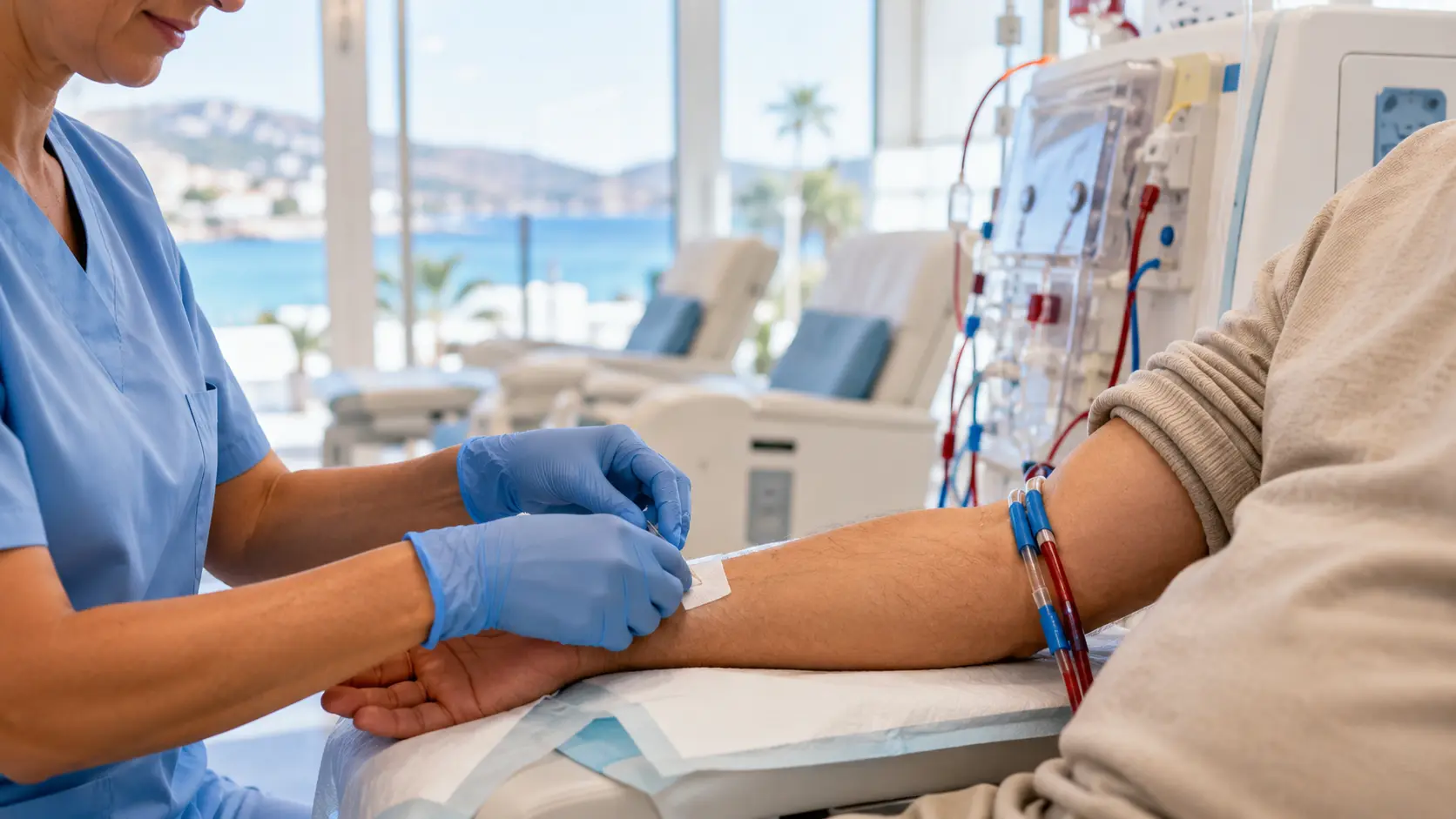
Buttonhole Puncture for Dialysis: Gentle shunt puncture, less pain, and greater safety thanks to specialized training in Mallorca.

A functioning vascular access is of critical importance for dialysis patients. The so-called shunt is not merely a medical prerequisite for treatment—it is the lifeline of dialysis. This makes it all the more important to protect this access over the long term and to handle it as gently as possible.
The type of puncture plays a crucial role here. This is because the shunt is punctured again during every dialysis treatment. How this puncture is performed can have a major impact on pain levels, the skin, the vascular structure, aesthetics, and the long-term stability of the shunt.
Essentially, there are two different procedures: the traditional ladder-stitch puncture and the modern buttonhole puncture, also known as the buttonhole technique. Both methods take different approaches. While the ladder-stitch puncture involves selecting new puncture sites at regular intervals, the buttonhole puncture uses the same puncture channel every time.
The Knitted Ladder Puncture
The ladder-puncture technique is a classic, standard procedure in dialysis. With this method, a new puncture site is selected along the usable length of the shunt for each treatment. The goal of this method is to distribute the puncture sites and allow the tissue time to regenerate between treatments.
Sharp needles are typically used for this type of puncture. Changing the puncture site regularly is intended to prevent excessive strain on specific areas.
In practice, however, it has become apparent that risks remain despite this approach. Repeated injuries in different areas can put long-term strain on the vessel and the overlying skin. This can lead to localized bulges in the vessel, known as aneurysms. Narrowings, medically referred to as stenoses, can also develop.
For many patients, these changes are not only medically significant but also aesthetically distressing. Prominent aneurysms can become visible and affect a patient’s quality of life. In extreme cases, the skin over the blood vessel becomes thinner, which can further compromise its stability.
The Buttonhole Puncture
The buttonhole puncture takes a different approach. With this method, the exact same puncture site is used for every dialysis session—at the same angle and to the same depth.
These repeated punctures at the same site cause a firm puncture channel to form from scar tissue. This channel is similar to the hole in an earring. Once it is established, punctures are no longer made with a sharp needle, but rather with a blunt cannula.
The big advantage: The blunt needle glides through the existing channel. This prevents the surrounding tissue from being injured each time. It also reduces the risk of accidentally puncturing a blood vessel.
When performed cleanly and consistently, the buttonhole puncture can help keep the vessel flat, stable, and inconspicuous. Since there are no new puncture injuries, the compression time after treatment can also be significantly shorter.
Pain Relief and a Better Quality of Life
For many dialysis patients, the needle insertion is one of the most unpleasant parts of treatment. Repeated needle insertions can be not only physically painful but also emotionally stressful. Therefore, any improvement in the needle insertion process plays an important role, especially for patients who have relied on regular dialysis for many years.
The buttonhole puncture can make a significant difference here. If the puncture channel has been properly created and remains stable, the blunt needle glides through an existing, less sensitive channel. As a result, many patients find the puncture much more comfortable and, in some cases, nearly painless.
However, the procedure requires the utmost precision. In particular, the channel must be created with great care. It is crucial to always use the exact same puncture site at the same angle. This is the only way to ensure that a stable and secure puncture channel develops.
It is equally important to maintain strict hygiene during the procedure. As with any puncture, there is a risk of infection with the buttonhole puncture if the procedure is not performed in a clean and standardized manner. However, if the procedure is performed properly, it can help protect the shunt and reduce long-term complications.
Aesthetics, Stability, and Long-Term Shunt Maintenance
In addition to pain relief, long-term maintenance of the shunt is also a key goal. A properly functioning shunt is of enormous importance to dialysis patients. Any complication involving the vascular access can complicate treatment and necessitate additional medical interventions.
The ladder-puncture technique spreads the punctures over a longer distance. Nevertheless, repeated trauma can lead to visible changes. Aneurysms, in particular, can be distressing for patients, as they are often clearly visible and significantly alter the appearance of the vessel.
When performed correctly, the buttonhole puncture can help prevent such changes. Since new puncture sites do not constantly form, the vessel often remains flatter and less noticeable. For many patients, this means not only greater medical safety but also greater well-being in everyday life.
For people who require long-term dialysis in particular, a gentle puncture method can therefore make a significant contribution to their quality of life.
Our Expertise: Buttonhole Training in Mallorca
At our center in Mallorca, we have specialized extensively in this minimally invasive method. The history of the buttonhole puncture at our center dates back to our very first patient. She came to us from Denmark—a country where this method was developed and has been used with great success for over 25 years.
Based on this experience, we have adapted the Danish methodology and offer interested patients targeted training in the buttonhole puncture technique.
Our goal is to help patients learn about a gentle, safe, and beneficial long-term puncture method. At the same time, we also want to help dialysis centers and specialists gain greater confidence in using this technique.
How do our training sessions work?
The buttonhole training at our center in Mallorca is clearly structured. The stitch channel is carefully created and then prepared for use with blunt needles.
The time required is manageable: We can finish the buttonhole at our center in about an hour.
During this time, the channel is formed by inserting a sharp needle exactly into the same puncture site approximately three to four times. Precision is crucial here. The puncture site, angle, and depth must all be consistent so that a stable channel can form.
Immediately afterward, switch to the blunt needle. Once the puncture channel has been established, the puncture can be performed through this channel.
For patients, this procedure can be a great relief. Instead of having to undergo repeated punctures, an existing channel is used. This can make the treatment more comfortable and reduce the strain on the shunt.
Why Implementation Is Often Difficult
Although buttonhole puncture can offer many advantages, it is not yet widely established in many dialysis centers. Patients therefore often face the challenge of convincing their treating physicians or dialysis teams of the benefits of this method.
This is not necessarily due to a lack of willingness, but often to a lack of practical experience with the technique. The buttonhole puncture requires a very precise approach and a well-coordinated team. If it is not performed consistently and correctly, its benefits may be lost.
This is exactly where we come in. We want to share our experience and provide professional support to patients, nephrologists, and dialysis centers. Our goal is to teach this method in a way that is easy to understand, safe, and practical.
Who might be interested in buttonhole puncture?
Buttonhole puncture may be of particular interest to patients who require long-term dialysis and wish to preserve their shunt as gently as possible. Patients who experience severe pain during puncture or who are concerned about cosmetic changes to their shunt may also benefit from this method.
However, whether buttonhole puncture is appropriate in a particular case must always be determined on a case-by-case basis through medical evaluation. The condition of the shunt, the vascular anatomy, the patient’s history of punctures, and potential risk factors all play an important role in this determination.
For this reason, switching to buttonhole puncture should always be discussed with experienced medical staff and the treating dialysis team.
Do you have any questions about buttonhole puncture?
If you are a patient interested in our buttonhole training in Mallorca, please feel free to contact us. We’ll explain the process to you, review the options together, and help you plan the next steps.
Dialysis physicians or dialysis centers that need technical support in implementing this method can also contact us directly at any time. We are happy to share our experience and help make the buttonhole puncture a safer and more straightforward procedure in clinical practice.
Buttonhole puncture is more than just another puncture method. When used correctly, it can contribute to greater comfort, safety, and quality of life during dialysis.
Medical Note: This article is intended for general informational purposes only and is not a substitute for individual medical advice. Whether buttonhole puncture is appropriate for you should always be decided in consultation with your nephrologist or dialysis team.